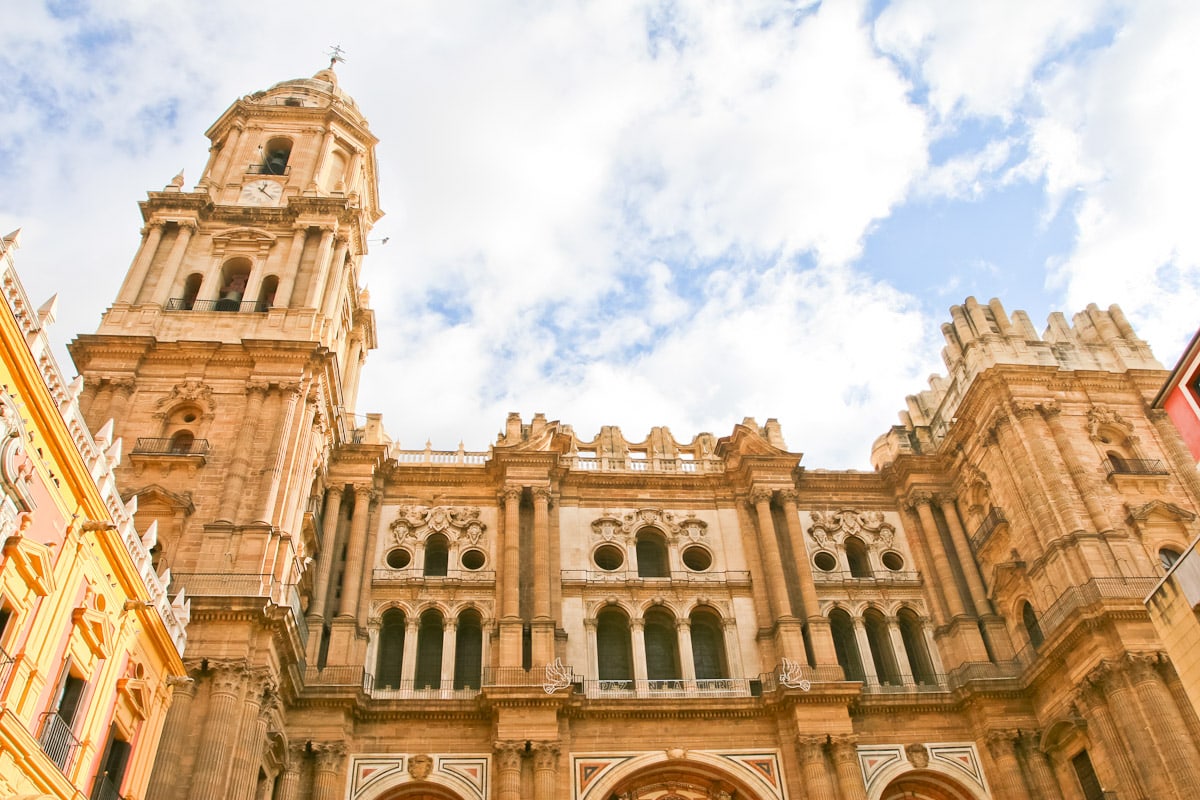
From Edinburgh, we flew to Malaga (MAH-lah-gah), on the southern coast of Spain, in search of warmer weather. What a contrast in a few hours! Like Edinburgh’s Royal Mile, the old part of Malaga has narrow stone streets and tall old residential buildings with bars and restaurants on the ground floors. There’s a great stone cathedral dominating the area, and a castle on a hill.

But unlike Edinburgh’s beige and gray stone, Malaga is white and pastel: tall curving buildings with tall windows and wrought-iron balconies (some big enough to sit on; others useful only for holding potted plants or keeping toddlers from falling out of windows). Palms and orange trees abound in the plazas. The feel is part Mediterranean, part New Orleans, part Tucson or southern California (because of the dry scrubbiness of the hills).


Malaga is a very old place. It was originally a Phoenician port, then a Roman one, and after that it was controlled (successively) by Visigoths, Arabs, and Spaniards. After the Christian reconquest of southern Spain, Malaga was a bishopric, and its cathedral is beautiful (much better than Granada’s, in our opinion).
Don’t mind the drive in from the airport, which goes through some drab-looking, workaday parts of town. Malaga gets more interesting as you get to the historic center of the city. Half of the old section is under scaffolding, but the other half is very picturesque. Lots of (mainly) pedestrian streets good for strolling slowly in the late afternoon.

On one of our walks, we saw an amazing sight: a five-story building, covering half a city block, whose inside had been totally demolished. All that remained was the building’s outer shell, all the way around, resting on pillars where the ground floor had been. A great foundation hole gaped in the center. Once the building has been restored, the old part will literally be a facade. So much nicer than building some modern thing that doesn’t match the neighborhood.