


When Melissa and I began vagabonding, 18(!) years ago, we started our long European backpacking trip with a three-week stay in the storied city of Granada. Then, it was a place to study Spanish and to start learning about the history and culture of southern Spain. Now, on our second visit, Granada is a stepping stone on our path to Morocco.
The city is well-suited to both roles, because it’s such a crossroads of cultures. For more than 750 years, Granada was ruled by Muslim dynasties from North Africa. For much of that time, the city was a vibrant mix of Muslims, Jews, and Christians of various ethnic backgrounds. Their cultures influenced the city long after the Catholic reconquest in 1492. Today, you’ll find quintessentially Spanish tapas and wine bars interspersed with lots of Moroccan and Middle Eastern restaurants.
During our previous visit, in 2008, we wrote about Granada’s historic sites in great detail. What’s different 18 years later are things like avocado toast and Asian fusion tapas on menus, a new metro system linking the city’s outskirts to the center, and more Central American faces, as Spain encourages immigration from Spanish-speaking countries. There are also more tourists in Granada than there were 18 years ago—and some backlash to the growing numbers (expressed in banners on apartment balconies that say things like “Your noise ruins our living” and “Say no to mass tourism”).

Then, as now, most of Granada’s tourists come to see the Alhambra, a famous complex of fortresses and palaces built by the Muslim emirs of Granada in the 13th and 14th centuries. When I was in my teens, I had a big picture book called Great Architecture of the World. The two-page spread on the Alhambra ignited my desire to visit what looked like the most beautiful building in the world. Seeing it in person in 2008 confirmed that view. Eighteen years later, having visited so many more places, Melissa and I still think the Alhambra has the loveliest architecture we’ve ever seen. It’s just magical.


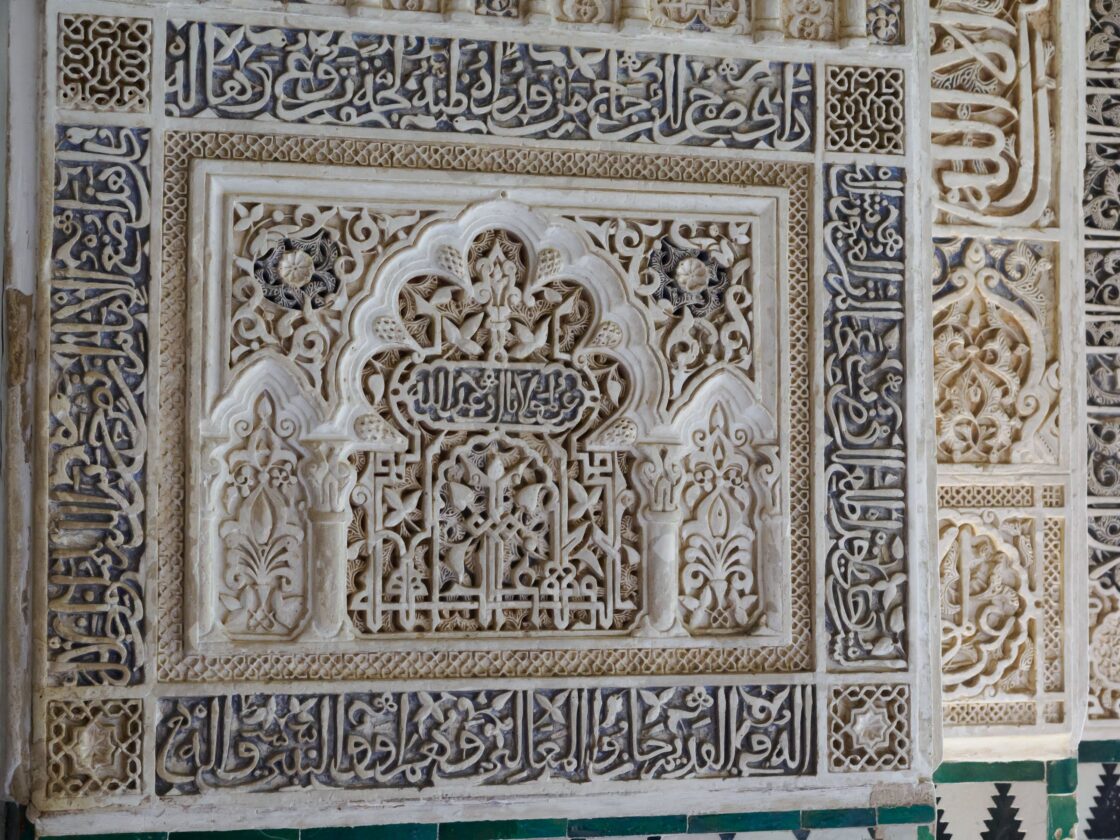

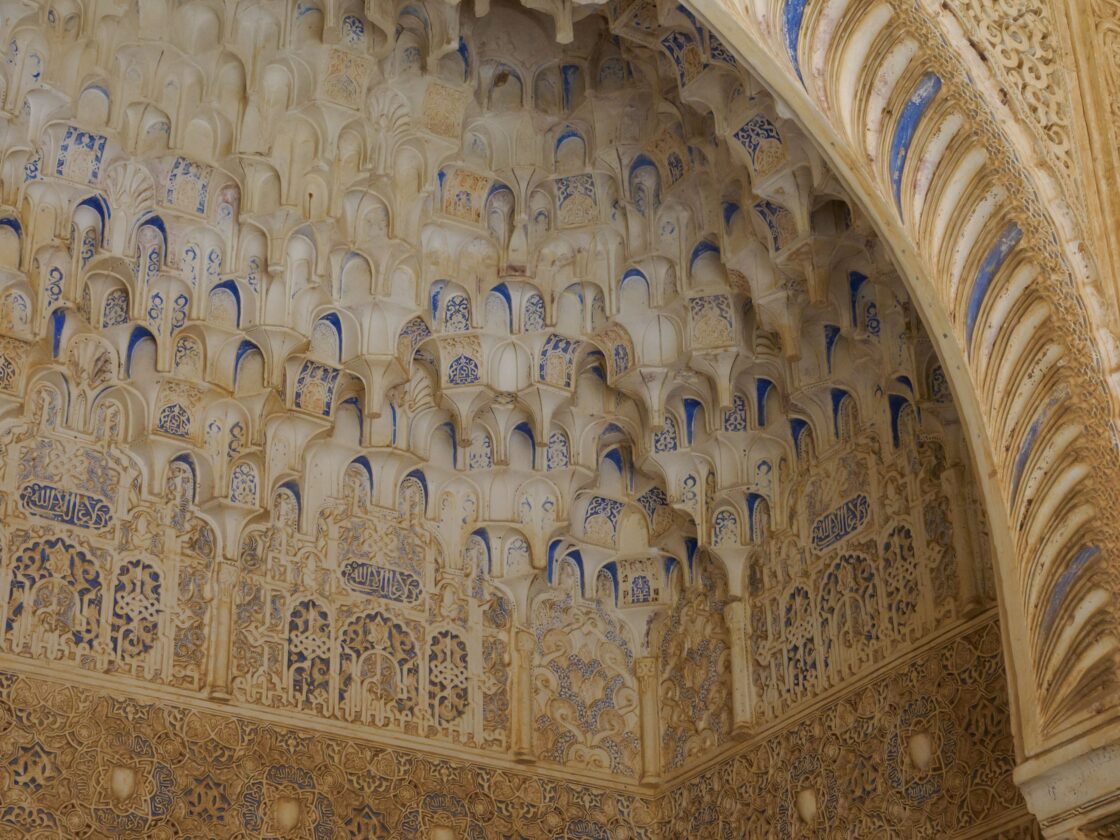
While touring the Alhambra this time, we made a fun and unexpected connection to our previous visit. By the time we planned this trip, individual tickets to the palace complex had sold out, so we had to book a group tour to make sure we could see it again. Our tour guide took us to a nearby workshop where artisans use a technique called marquetry to make inlaid wooden objects with intricate geometric designs like those in the Alhambra palaces.
I remembered that we’d visited the workshop before and that Melissa had photographed one of the artisans at work. Scrolling through her 2008 Alhambra gallery on my phone, I quickly found a picture and showed it to our guide, asking if he knew the man. He said no and showed it to one of the artisans, who peered at it for a minute and then exclaimed delightedly, “That’s my brother.” The brother, Miguel Laguna, came over, looked at the picture, and confirmed with a laugh that it was indeed him, looking much younger and with lots more hair. Expanding the photo to see what he’d been working on then, he chuckled, pointed to a nearby rack of tools, and said, “I still have that hammer!” While some things have changed in 18 years, some lovely things are still the same.

The shop was too crowded—and our guide in too much of a hurry—for me to stop and take a picture of Miguel holding the earlier photo or his old hammer. But he slipped me his card and made me promise to send him the 2008 photo. When I did, he thanked me enthusiastically for the unexpected trip down memory lane.


Comments
3 responses to “Back Where It All Began, in Granada”
How cool! For Miguel to see that pic! I’m sure not many tourists have done that for the artisans! Or that tourists have the opportunity to visit the same place again.
I wish we had more chances to revisit people like that. I have so many pictures of people from 20 years ago that they might be tickled to see!
Aw, what a lovely meeting! ❤️ Experiences like that are heartwarming!