
Riding across the Yucatan Peninsula on the bus, you’re struck by the flat landscape and dense, low forest in many different shades of green. There are few farms in sight, and villages are widely separated. Colorful flowering trees and vines abound. But what makes the Yucatan unique is its water.
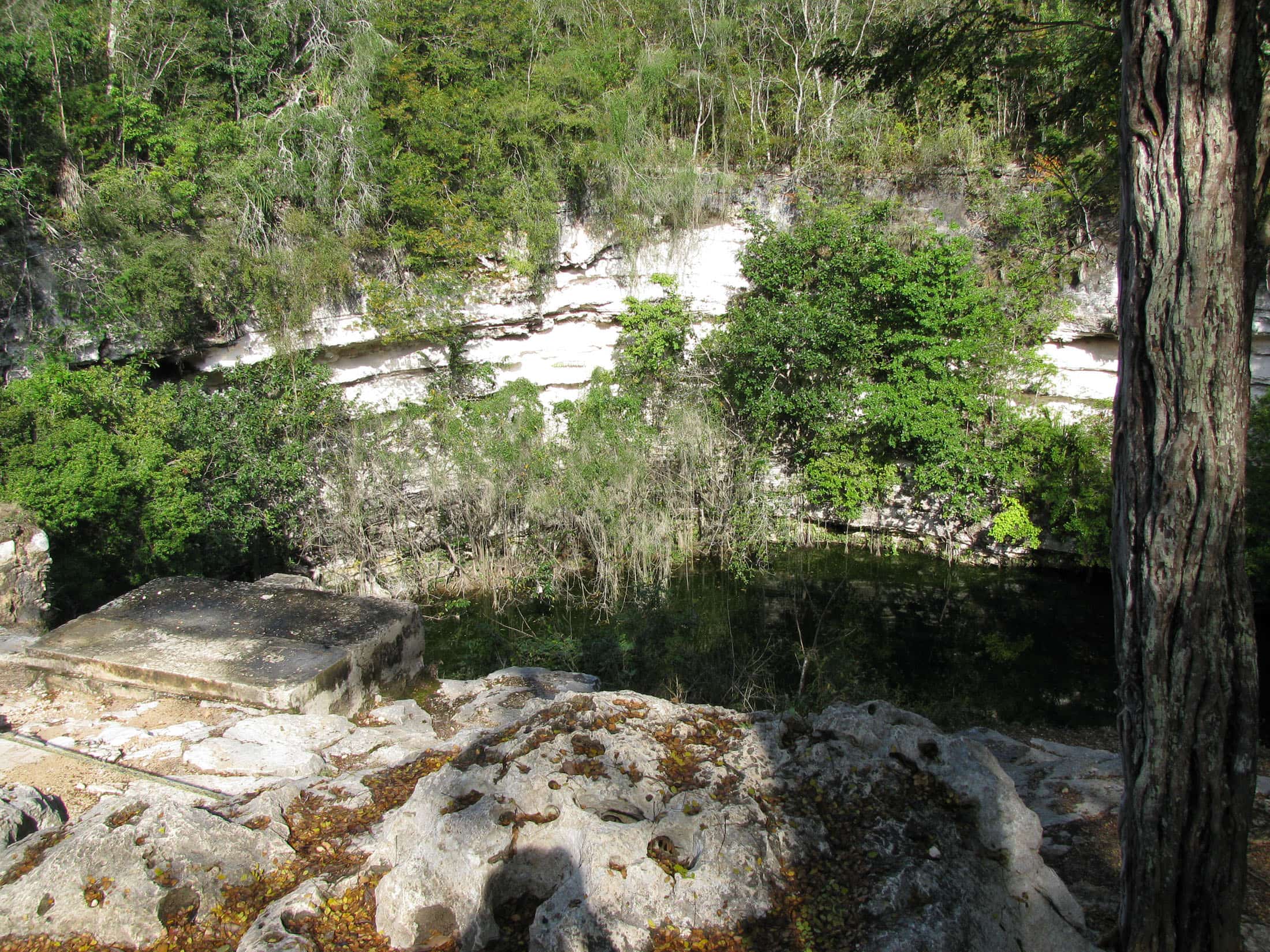
This large peninsula has only a few lakes and no rivers or streams—on the surface, that is. Instead, rainwater seeps easily through the porous limestone shelf that underlies the peninsula and collects in a vast, interconnected network of underground rivers and caves. Eventually, the ceiling of a hollowed-out cave collapses, forming a sinkhole—called a cenote (seh-no-tay)—that leads to the water below. There are hundreds of cenotes, large and small, all over the Yucatan.
Scientists think this strange landscape may have resulted from the huge meteorite that hit northern Yucatan 65 million years ago. Besides throwing up enough dust to block sunlight and kill the majority of species on Earth (including dinosaurs), the meteorite shattered this region’s limestone shelf into fragments. After that, erosion took over on a big scale.
For the ancient Maya, cenotes were the main source of fresh water and were regarded as sacred. The Mayan underworld was (understandably) thought to be a deep, watery place, and the dark, mysterious cenotes were its entryways. Temples were built above or near cenotes, and sacrifices of people or objects were frequently thrown in. Some of the best Mayan artifacts that now exist were dredged from the bottom of cenotes, such as those at Chichen Itza.
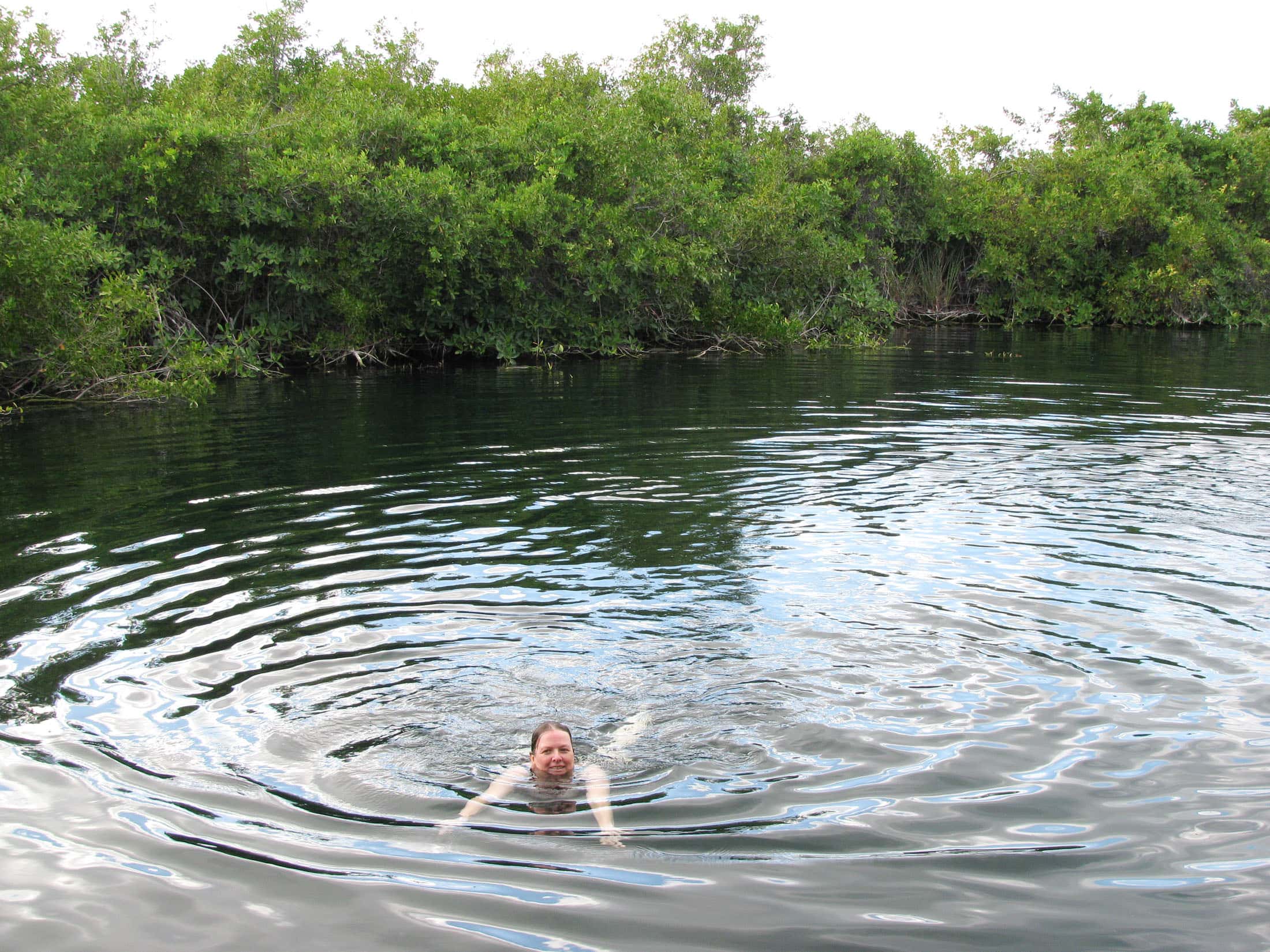
Today, the more accessible cenotes are favorite swimming and snorkeling spots. On a recent day, when the ocean was too rough for snorkeling, we decided to visit Gran Cenote a few kilometers from the town of Tulum. At first glance, it didn’t look like much: an oval hole in the ground, maybe 50 feet by 30 feet, with limestone walls covered in vegetation. Steps led down about 20 feet to a pool of dark, cool water, with some wooden docks and ladders built over it. The water looked forbidding, and the cold took some getting used to. But once we were in, it was one of the most amazing snorkeling experiences we’ve ever had.
Snorkeling in Gran Cenote is worlds away from snorkeling in the ocean. You’re in the middle of a cave, sometimes with the sky above you and something with the ceiling of the cave arching high overhead. The floor beneath you is stone or sand, with the depth of the water ranging from a foot or two to perhaps 20 feet. The water is amazingly still and clear. Light carries a long way, reflecting off the beige limestone walls and roof and tinting the water weird shades of neon blue. There are some fish in Gran Cenote (a couple of innocuous-looking varieties, up to about 8 inches long), but no other visible life.
The interesting features here are the cave itself: submerged stalagmites, great heavy masses of tree roots coming through the ceiling of the cave and down into the water, and wholly submerged crevices and passages sloping down away from you into the dark, where the scuba divers like to explore. (I think they’re crazy! I’ll stick to partially submerged places where I have air above me rather than water and rock).
This is the first place we’ve ever snorkeled where what’s above you is as cool as what’s below. You keep lifting your face half out of the water to look at the trees and plants lining the cenote or the stalactites and other formations on the roof of the cave. With so much three-dimensional space around you, it feels a bit more like diving than snorkeling in that you have to be conscious of where you are in relation to what’s around you. Also, it’s a joy to snorkel in fresh water. No salt water seeping into your mask and burning your eyes or throat. You don’t emerge thirsty or have to wash the salt off your clothes and gear afterward.
We snorkeled for about an hour and only stopped because we were getting cold. If not for that, we could have looked at everything much longer, even though this is a fairly small cenote.
