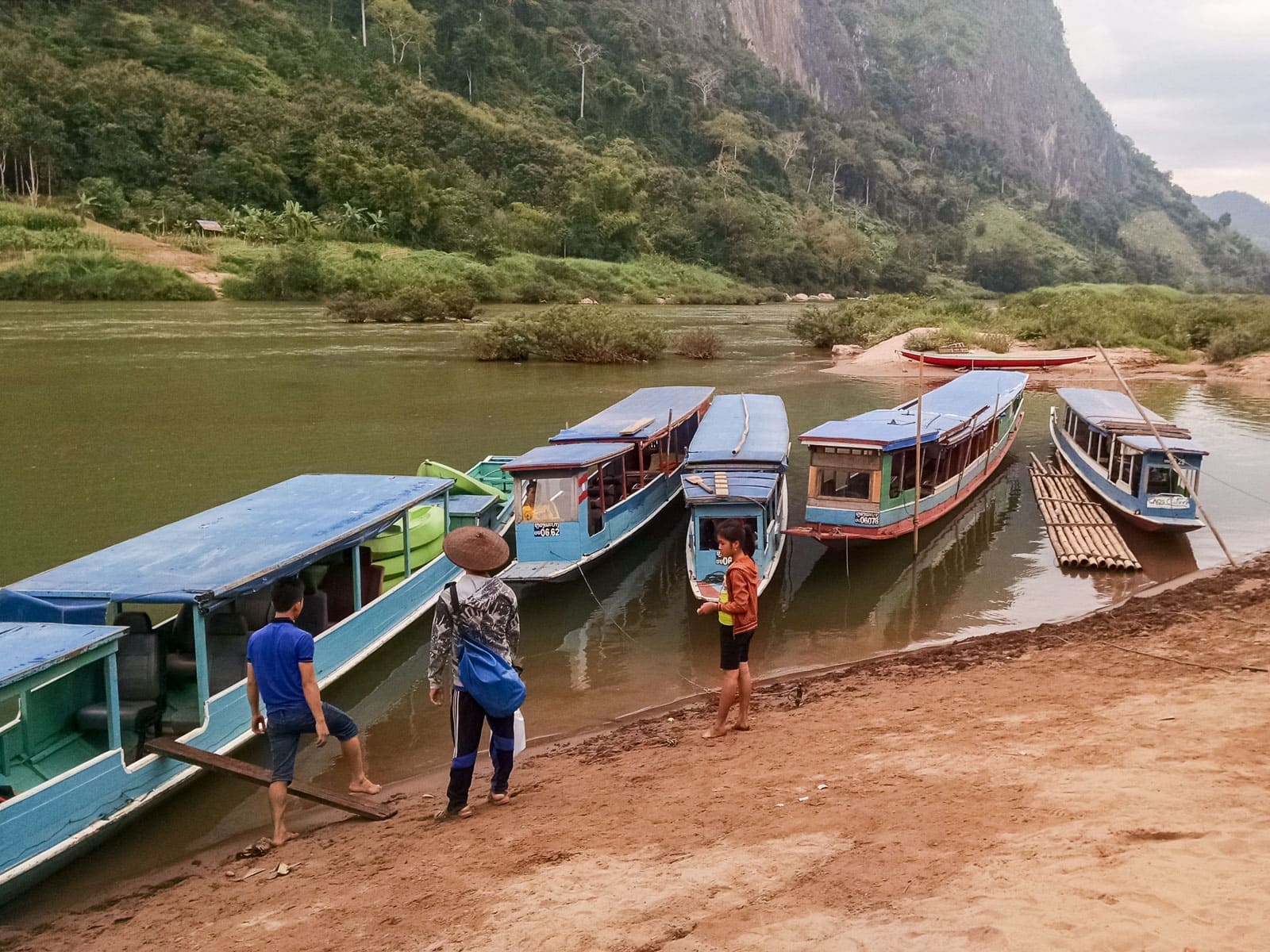
After Luang Prabang, it was hard to believe that Laos could get any prettier. But four bumpy hours north by minivan is the little town of Nong Khiaw, whose dramatic mountain scenery left us gaping. Nong Khiaw sits where two regional transport routes—a paved road and the Nam Ou river—meet. It’s really two villages, one on each side of the river, linked (since 1973) by a tall concrete bridge. We knew this would be the kind of quiet, relaxed place we love because, under “Sights,” the guidebook said “It’s hard to beat just standing on the bridge and gazing at the river.”

After looking at some dark, stuffy bungalows with saggy beds—which had the feel of old family vacation cabins that haven’t been aired out all winter—we opted for the fanciest budget-priced guesthouse in town, Vongmany. There, $10 a night got us a large, brightly lit room with painted white walls, a screened window (so we could sleep with the window open), a decent bathroom with a hot shower, and a terrace looking out to the river and the mountains.
Within a couple of blocks were an ATM, a local tour agency that organizes boat trips and rents bicycles, and half a dozen restaurants—including one, called Chennai, that serves very good, well-spiced Pakistani and northern Indian food. Those rich flavors were such an unexpected delight in a small, out-of-the-way place that we ate there two of our three nights in Nong Khiaw.

Our guesthouse also had a restaurant, which became something of a second home for us. In fact, it doubled as a living room for the family who ran it, so while we were eating or working there, we felt like part of the family ourselves. Often, the younger kids were sprawled on a floor mat playing, while older kids did homework at one of the tables (in between handing out menus or delivering plates of food) or watched the little TV in the corner. Everyone took turns holding the baby of the family, little Thony, who had a cute superman outfit and a basket cradle hanging from the ceiling.

One evening, while stopping to pick up the laundry we’d dropped off earlier, I was distracted by a soccer match between Thailand and the Philippines that most of the family was watching on TV, in between serving dinner guests. I’d only been looking for a moment or two when a young relative brought me a chair, so I sat down like an honored guest, next to the other older members of the family. Together we cheered and sighed in exasperation at the players and conversed in broken English about the game. It was fun to feel like I was back in a friend’s living room.
As the guidebook predicted, our main pastime in Nong Khiaw was gazing at the river and the limestone cliffs that tower above it. In addition, we strolled around the two villages looking at people’s homes and shops, and we explored the big street market that sets up by the primary school every Saturday morning. Among all of the usual clothes, household goods, produce, and meat, it was a surprise to see the bodies of several small forest creatures (maybe a weasel and a small ground hog) being sold for cooking. Apparently, hunting small animals in the forest with snares is an important way for people in the area to get meat.

Another surprise was seeing oranges for sale everywhere, neatly piled into big pyramids on vendor’s mats by the side of the road. For a while we couldn’t imagine where they were coming from, until we finally spotted some oranges on trees around Nong Khiaw. Who knew that oranges grow in the mountains? (Other than Laotians, of course.)
Staring for a while at the same bends in the road and the river made us eager to see what lay beyond them. So one afternoon, after doing our editing work, we rented bicycles and rode along a quiet paved road through villages and lush green countryside. Since it was a hilly area, there were plenty of taxing uphill parts of our ride, but we were rewarded with exhilarating coasts downhill.

After a few kilometers, we came to a place called Tham Pathok, where a towering limestone formation rises out of a rice field next to a stream. About 100 feet above the ground are a series of caves where local villagers and much of the communist government of Luang Prabang province lived during the second Indochina war to escape American bombing.
The cave (reachable now by steep stairs) has a narrow opening that can be hard to see from below but widens into a tall, dark chamber, which winds around the corner in pitch darkness until it reaches another opening, high on the rock face, that provides some daylight. It’s eerie to think of hundreds of people living there for months at a time. Signs point out where different parts of the government were headquartered in the cave complex and where artillery was placed at the cave mouth. Today it’s such a quiet, peaceful landscape, with a few rice grains trampled into the ground attesting to the recent harvest and small boys playing in the stream near some villager’s fish trap.

The next day, we finally had a chance to explore the beautiful Nam Ou river by taking a boat trip up the river, stopping at several small villages, and then kayaking for a couple of hours back down to Nong Khiaw. The mountain scenery that unfolded around each bend was gorgeous.


It was fascinating to see how life revolves around the river. We passed villages hidden behind high banks, the only clues to their presence a few boats tied up on shore, a track disappearing into the woods, vegetable gardens on the banks, or cattle and water buffalo left to graze along the shore (because there’s nowhere for them to wander off to).
I’d always thought that water buffalo got their name because they are used to plow flooded rice fields. But now I know that it’s because they like to submerge themselves in water like hippos, with only their faces and horns showing.

The two villages we stopped to visit up river (Muang Ngoi Neua and another whose name we’ve forgotten) are accessible only by water, so they’re quiet places without any cars. Other than that, they look a lot like other villages we’ve seen—small temple, schools, people weaving or doing cross stitch or cooking. But just a few years ago, the villages got electricity, thanks to a series of sturdy poles marching up and down hills along the river (those must have been a challenge to install without roads). And as we were leaving one village, students from the primary school were lined up to welcome the district’s Library Boat, which plies the river bringing books to schools.


Our kayak trip back down the river was fun, with beautiful views and just enough rapids to get a little wet. But when the river widened out, the current dropped, and the sun came out from behind the clouds, paddling got to be slow, hard work. We apparently looked so odd plodding along in our green kayak—Melissa with a straw hat and Chris with sunglasses and her jacket hood pulled up against the sun—that a local man in a passing boat took a photo of us! (We’ve taken so many pictures of Laotians that it seemed only fair.)
Until last year, it was possible to travel all of the way from Nong Khiaw back to Luang Prabang by river. But now the Nam Ou is blocked by a series of big hydropower dams that a Chinese-Laotian consortium is building (for better or worse—many local people are opposed to the project). We thought that meant another long, uncomfortable bus ride back to the south. But we got lucky in that enough other visitors were planning to leave Nong Khiaw the same day we did that a local tour company booked a boat to take us two hours downriver to the dam, where we could switch to a minivan for the rest of the trip back to Luang Prabang.
So, sad as we were to leave Nong Khiaw, we did it in the best way possible: motoring slowly down the broad river, in a wooden boat with open sides and old car seats bolted to the floor for a comfortable ride, watching forests and gardens and soaring cliffs go by.