
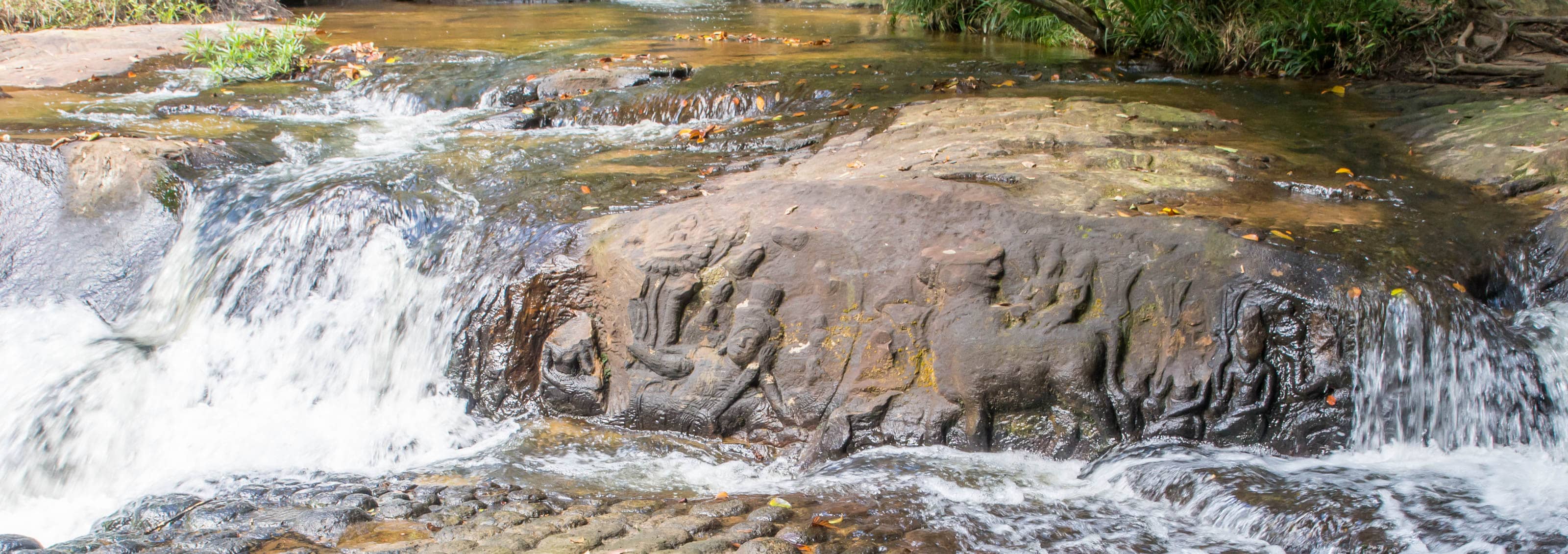

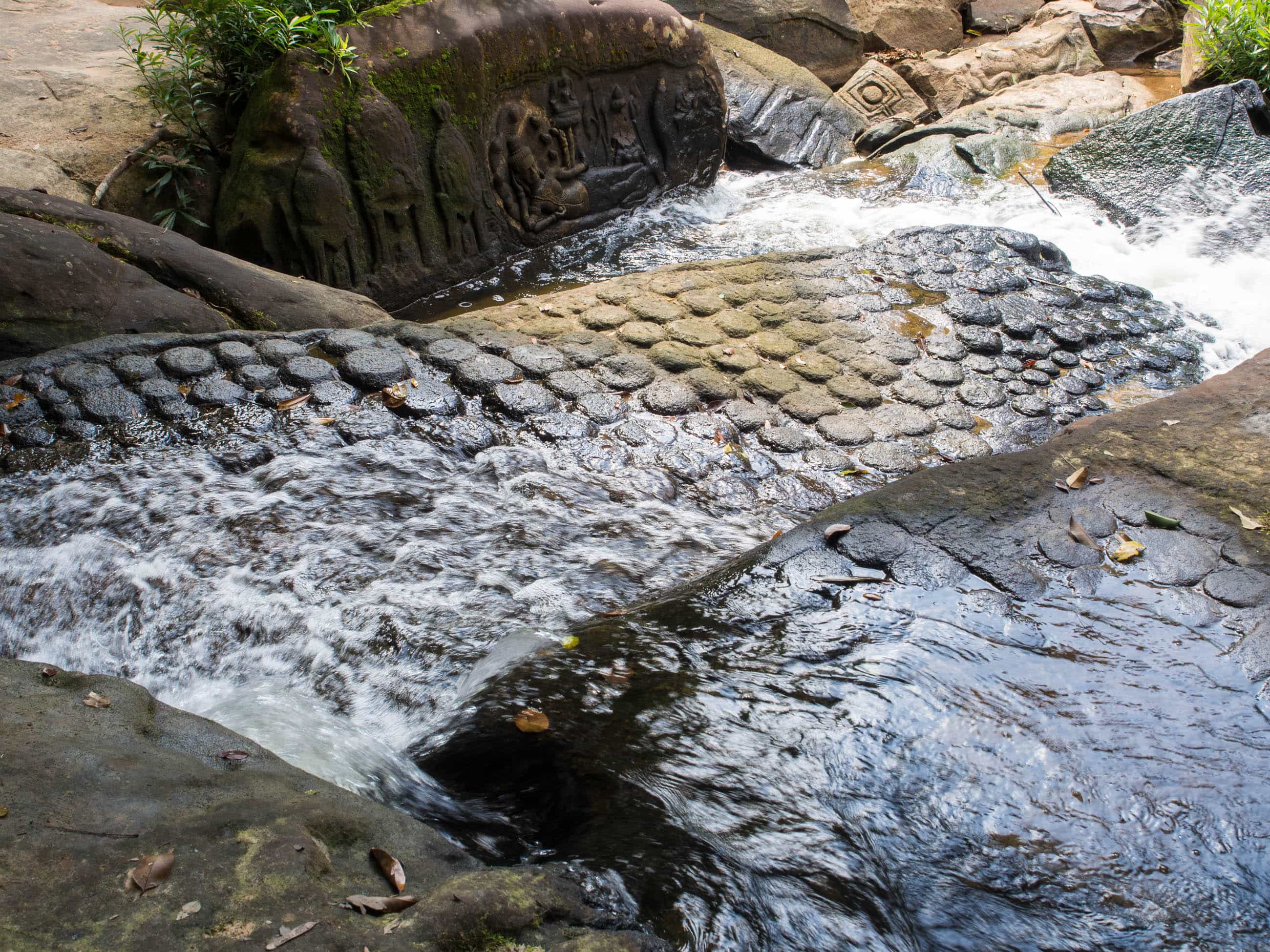
Some 60 kilometers from flat Siem Reap, on the side of the Kulen Mountains, is one of the most remarkable ancient Khmer sites: not a soaring temple but a splashing river whose sandstone bed was carved with Hindu imagery, sanctifying the water as it flowed over the holy images.
The river, Kbal Spean, rushes down a hillside covered with thick forest and large boulders. Perhaps because of the terrain, the carvings—which are thought to date from the 11th or 12th century—were not rediscovered until 1968 (within Chris’s lifetime). Discoveries continue at the site, with new carvings found as recently as 2005. Many more may still lie buried under moss and vines and trees. The Kbal Spean flows down to join the Siem Reap river, which then meanders past the many temples of the Angkor complex—including the less famous, but still pretty, temples of Baphuan and Pre Rup.
The last of the ancient Khmer temples that we visited in Cambodia was Banteay Srei. Its size and color set it apart from the imposing gray bulk of Angkor Wat-style temples. Banteay Srei is a beautiful small temple built in 967 from terra-cotta-colored sandstone by a counselor to the king. Its miniature scale—low walls, small doorways, and shrines no more than 30 feet high—may reflect the counselor’s desire not to be seen competing with the king in grand temple building.
Although small, Banteay Srei boats more intact decoration than any surviving Khmer temple. Unfortunately, it’s very popular, and the small size packs all the tourists into a tight space, so despite its beauty, it wasn’t as much fun to explore as the other temples.


