
Three days isn’t enough time to fully explore any big city, and Dublin is no exception. But since it’s an expensive place, and we were eager to get to France, that’s how long we gave ourselves there. We skipped some of the main tourist spots, such as the Guinness brewery (because neither of us likes beer), St. Patrick’s Cathedral (because we’re going to see lots of Gothic cathedrals in France), and annoyingly, the Book of Kells (because we got there too late on our last day in Dublin).
Instead, we spent much of our time in two great museums: the National Museum of Ireland and the Chester Beatty Library. The national museum is full of fascinating archeological finds from all over the country, many of them from the Bronze Age (roughly 2,000 to 500 BC) and earlier.
There are beautifully polished stone axes; bronze daggers, spear points, axe heads, and cauldrons; and wonderful gold torcs and clothing fasteners and gorgets, looking as bright and shiny as if they were in the window of a jewelry shop. There is also lovely Bronze Age pottery of a style unlike anything we’ve seen elsewhere: small rounded clay bowls with stippled or slash-mark patterns all around them, some made by pressing cords onto the surface of the clay before firing. Very intricate and delicate looking.
We spent so long admiring all of those things that we had to rush through the rest of the collection: various Viking artifacts; medieval pottery and ironware and reliquaries; and clothing from the 1600s preserved on bodies found in bogs. The museum also has some much older (Iron Age) “bog bodies” themselves on display. Historians now think that the proliferation of bog bodies discovered along ancient tribal boundaries and on royal land links them to sacrificial rituals associated with sovereignty and kingship during the Iron Age.
Our other favorite spot, the Chester Beatty Library, is a must for anyone who loves books or history or art. Mr. Beatty was a wealthy American and avid collector at the beginning of the 20th century. He amassed vast collections of almost anything to do with books or printing, including Egyptian papyruses, illuminated manuscripts, Asian prints, rare Chinese “books” carved of jade, and much, much more. Many of the highlights are on display in the museum section of the library.
As much it blew our minds to see 2,000-year-old Roman paintings from Pompeii, it was even more incredible to be looking at a 3,600-year-old papyrus sheet of Egyptian love poems. How could something that delicate survive so long?
Almost as amazing are some of the earliest-known copies of parts of the New Testament (from 100 to 200 AD) and the Koran (from around 700 AD), as well as early Buddhist, Hindu, and Confucian texts. Just think how much influence those small scraps of paper have had around the world over the centuries. We were lucky because when we were there, the library also had a special exhibition of Rembrandt etchings from his museum in Amsterdam.
We also visited the national gallery of Ireland. One of the highlights for us was a nice Caravaggio painting of the taking of Christ—not as fine as works of his that we saw in Rome but still good. There was a lovely painting by Murillo (an artist from Seville) of the holy family, with Joseph handing the baby Jesus to a very peasant-looking Mary, and a bright Perugino altarpiece. The museum also had some nice Dutch portraits, but alas, its Vermeer (of a servant woman in brown standing to one side while her mistress reads or writes a letter) was off in Tokyo. The museum was better than the Scottish national art museum, but it was still mainly a second-rate European collection (in that most of the paintings by major artists were lesser works), not on a par with the collections in DC, New York, and various European capital cities.
We made a little pilgrimage to walk past the childhood home of Oscar Wilde, one of Chris’s favorite historical people. On the way, we passed a school attended by 18th-century playwright Richard Sheridan (The Rivals, A School for Scandal) and by the Duke of Wellington (the Napoleonic wars). Nearby, we visited No. 29 Fitzwilliam Street, a Georgian-era townhouse museum restored to how it would have looked around 1794. The house has well-decorated rooms with lots of interesting objects and grand Waterford crystal chandeliers, rivaling Murano glass from Venice.
One of the objects especially fascinated Chris, who used to portray an 18th-century washerwoman in her reenacting days. It was a special device to help with washing laundry around 1800: a stick that ran into a wooden disc, from which extended five or six short rods at slight angles. It looked like a broom handle set into the top of a small, many-legged stool. Our guide explained that it was a manual “agitator” (like the one in the middle of a modern washing machine). You stuck it into the tub of hot water and laundry hanging on the fire and turned it to agitate the clothes. It was a great advance on the plain stick that people had used previously for that purpose.
That simple, mundane object was a good reminder of how, as we travel, we see (or hear or smell) new things just about every day. For so many people through so much of (pre-television) history, that just wasn’t the case. We’re very lucky in this wandering life to be always encountering and learning new things.
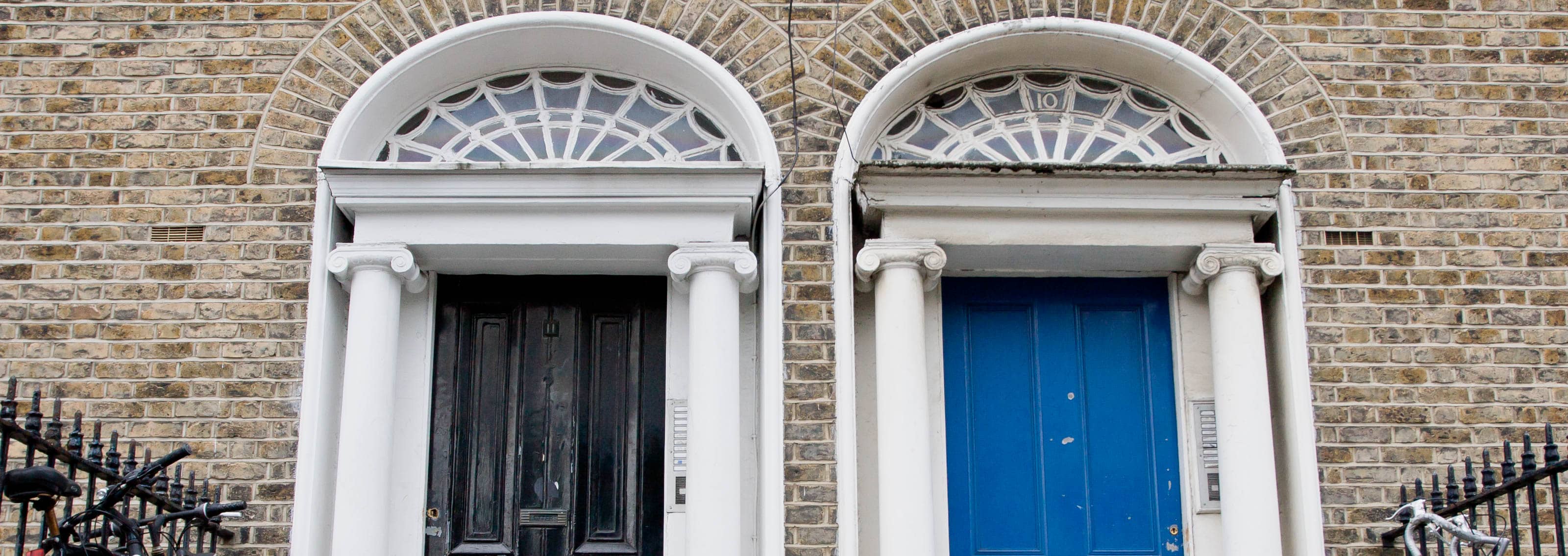
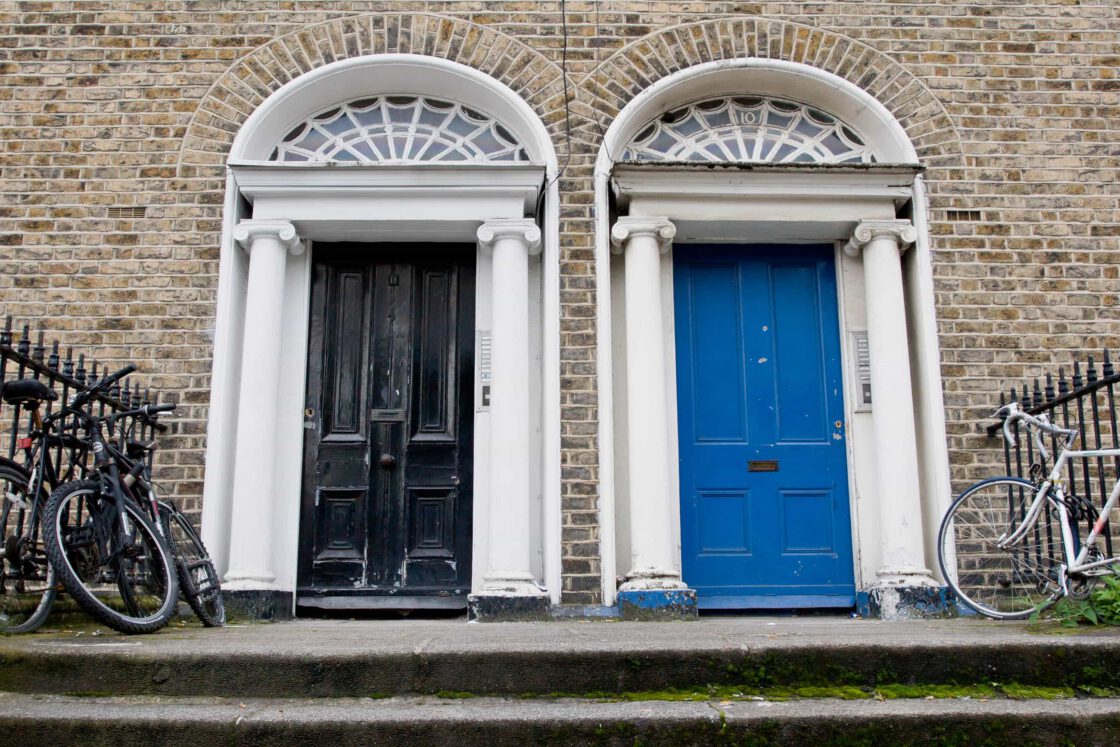
The colorful doors on Dublin’s Georgian-era townhouses have become a sort of symbol of the city. In the souvenir shops, you can find pictures of them on posters, calendars, key chains, and everything else. Although it rained almost continuously during our stay in Dublin—so we weren’t really able to take pictures —we couldn’t leave our readers without at least one door photo (see above).
More than anywhere we’ve been so far, Dublin feels like Washington, DC! Maybe it’s because we rented an apartment through Craigslist, as we did in DC after we sold our house. Our Dublin flat was in a close-in neighborhood of 1950s apartment buildings, small shops, restaurants, and 18th- and 19th-century brick row houses turned into office buildings. The area reminded us of upper Dupont Circle or Adams Morgan, albeit with more double-decker buses. Other ways in which Dublin is like Washington: free museums, ethnic restaurants (there was a Nepalese one around the corner), lots of coffee shops and bagel places (bagels seem all the rage there right now), groups of clueless tourists milling around on the sidewalks, leafy parks, and neo-classical government buildings. We felt right at home.
On our Saturday night in Dublin, we had a special outing. We went to a dinner show by The Merry Ploughboys (at a pub of the same name in the suburbs) at the invitation of one of the band members, Liam, whom we had met at a session in Molly’s Pub in County Donegal 10 days earlier. He got us a nice discount on the show. The food was copious and better than you’d expect in a 200-seat dinner-theater setting. The band (two guitars, Irish pipes/whistles, and a fiddle) played vigorously and well for an hour and a half and sang many familiar songs. There was also a mini-Riverdance interlude, with a half-dozen good step dancers in their teens and 20s performing.
Liam told us that after the show, there would be a session in the downstairs pub, where the band members would sing and play in a more relaxed atmosphere. We wanted to go, but when we got there, the bar area was mobbed and there was nowhere to sit or stand comfortably to listen. So we caught a cab back to the city, and Chris got out of having to sing in a much larger setting, which Liam had threatened to have her do. That evening seemed the perfect way to end our stay in Ireland: with good traditional music.
